
Best Electric Bikes by Riding Need
Start with the hassle you will feel most often: stairs, storage, school runs, short-rider fit, bad weather commuting, or whether the bike needs to replace enough short car trips to matter.
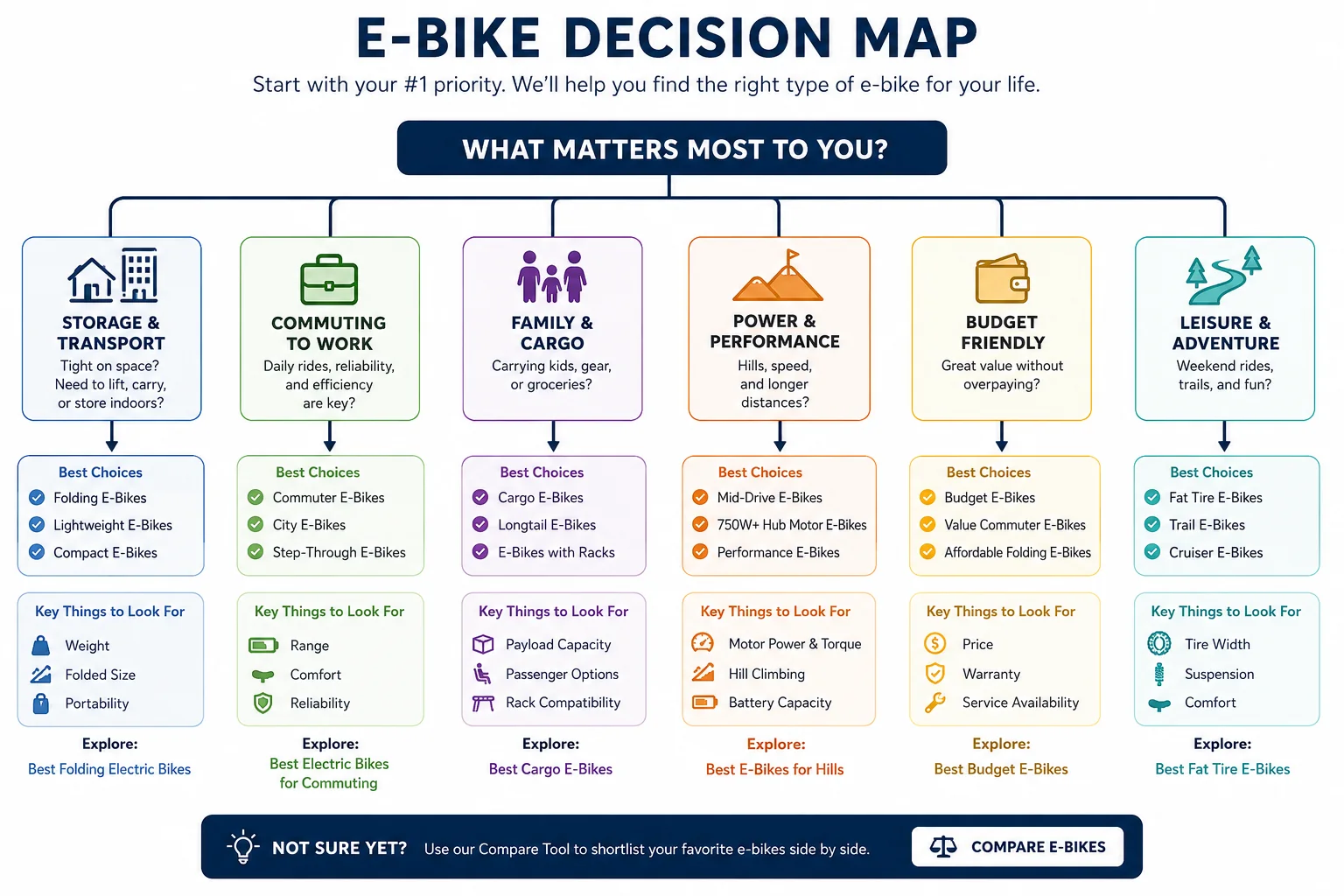
Choose the page that matches the real buying job
A good e-bike shortlist starts with the way the bike will actually be used. Pick the daily constraint first, then move into model guides, comparisons, and ownership checks.
Quick take
The fastest way to a good shortlist is to stop asking which bike looks best on paper and start asking which problem will make you regret the purchase fastest. Apartment buyers should start there. Family buyers should start there. Beginners should start with confidence and manageability, not the biggest battery or the flashiest motor.
You already know the main constraint: storage, hills, family duty, short-rider fit, or daily commuting.
You still need to decide whether an e-bike makes sense at all, or whether a lighter, cheaper, or non-electric option would solve the routine just as well.
Start with the kind of riding you actually need, then move into the comparison pages and ownership guides to check fit, support, storage, and daily practicality.
Start with the strongest shopping paths
Most riders narrow the field faster by choosing between value, commuting, storage, hills, and family cargo before comparing individual models.
- Best Budget Electric Bikes, Best Affordable Electric Bikes, and Best Electric Bikes Under $1,500 cover the value-shopping path.
- Best Electric Bikes for Commuting, Best Electric Commuter Bikes, and Electric Bike for a Work Commute cover the transportation path.
Start by the problem you feel most often
The best page to open first is usually the one tied to the daily hassle you cannot ignore. A bike that is excellent for a garage commuter can be a terrible apartment bike. A bike that looks like good value on paper can be the wrong answer if it needs to carry kids, fit a short rider confidently, or survive school-run duty without feeling sketchy.
Start with Best Electric Bikes for Commuting if the bike mainly has to make weekdays easier.
Start with Best Budget Electric Bikes if price matters most and you need to avoid false-economy bikes.
Start with Best Electric Bikes for Apartments or Best Folding Electric Bikes if stairs, hallways, or indoor space are the main concern.
Start with Best Cargo E-Bikes for Families if the bike needs to handle kids, bags, or school-run routine.
Guides that usually matter most
- Best Electric Bikes for Commuting — for riders who need repeatable weekday utility more than excitement.
- Best Budget Electric Bikes — for buyers trying to keep cost down without buying a support or battery headache.
- Best Affordable Electric Bikes — for value shoppers who can pay a little more to avoid obvious compromises.
- Best Electric Bikes Under $1,500 — for buyers with a firm price ceiling.
- Best Electric Bikes for Apartments — for stairs, hallway turns, battery-removal routine, and parking stress.
- Best Folding Electric Bikes — for riders who really do need smaller storage footprint, mixed transit, or car-trunk flexibility.
- Best Step-Through Electric Bikes — for easier mounting, comfort, and lower-drama daily use.
- Best Electric Bikes for Short Riders — for buyers who need real fit confidence, not just a small frame listed on the spec sheet.
- Best E-Bikes for Beginners — for new riders who need a manageable first bike more than the maximum specs per dollar.
- Best One-Bike-Household E-Bikes — for buyers trying to cover commuting, errands, and family utility with one purchase.
What usually separates a good shortlist from a bad one
The wrong shortlist usually starts with either too much optimism or too much spreadsheet thinking. Buyers tell themselves they will not mind lifting the bike, storing it, charging it, parking it, or loading a kid onto it several times a day. Then reality shows up. The better shortlist starts with the annoying part of ownership first, then asks what kind of ride feel, speed, and cargo ability still make sense around that.
Most common mistake
Starting with price or motor size before deciding whether the bike has to survive apartment life, family loading, short-rider fit, or repeated weekday commuting. Those practical constraints usually decide the category faster than the headline specs do.
Use this page with the comparison and ownership sections
Once you have the right category, do not stop there. Move into the comparison pages to pressure-test similar bikes against each other, then use the safety and ownership guide to make sure the charger, lock, service, and parking routine still look realistic.
How to narrow your shortlist faster
If you are stuck between categories, do not compare ten bikes at once. Eliminate entire categories first. Riders with stairs, tight hallways, or second-floor storage should cut out heavy long-tail cargo bikes immediately. Riders carrying kids should stop pretending a lightly accessorized city bike will feel the same as a purpose-built utility platform. Buyers who want one expensive bike to replace several categories of short trips should judge versatility harder than top speed or display features. The best choice is usually the bike that fits your daily routine with the fewest compromises.
- Apartment first: weight, removable battery routine, and parking beat flashy specs.
- Family first: passenger setup and low-speed stability beat style.
- Commuting first: support, range realism, and lock routine beat bragging-right motors.
Still unsure which category you even need?
Go to the E-Bike Buying Guide first, then come back here once you know whether you are really shopping for a commuter, a family hauler, an apartment-friendly bike, or a comfort-first all-rounder.
Use guide libraries when a “best” list gets too broad
Best-of pages are useful for orientation, but the final decision usually needs a model-specific or category-specific review path. These archives help you move from broad category to the real bikes you might buy.
Budget guide library
Affordable models, cheap-bike cautions, and value tradeoffs.
Commuter guide library
Daily-use models for work, errands, and repeat riding.
Folding guide library
Compact ownership, apartments, trunks, and storage-first decisions.
Cargo guide library
Family utility, passenger setup, groceries, and school-run use.
When specs start to blur together, use the Electric Bike Spec Comparison Chart to keep range, torque, weight, payload, and certification claims in context.
Model guides and brand pages
Once you know the category, move into the specific bikes and brands that keep showing up in real shortlists. These pages are built to answer who each bike is for, who should skip it, and what to compare before buying.
New practical shopping paths
Best Electric Bikes for Adults
A broader adult-buyer guide organized around commuting, storage, comfort, and support.
Best Entry-Level Electric Bikes
A first-bike guide for buyers who want useful, safe, and repairable rather than just cheap.
Best Electric Cargo Bikes
A broader cargo guide for errands, kids, groceries, and car-replacement trips.
Best Fat Tire Electric Bikes
A category guide for rough roads, sand, snow, comfort, and fat-tire tradeoffs.
How to use this page
This page is reviewed under ElectricBikeCompare editorial standards and published by Nofo Times LLC. The goal is to help you choose around fit, storage, charging, support, safety, and day-to-day ownership, not just the best-looking spec sheet. Where a page leans on manufacturer claims, we cross-check them against the practical tradeoffs buyers usually run into after purchase.
For the full site method, read How We Evaluate E-Bikes or contact info@electricbikecompare.com.