
Class 1 vs Class 2 vs Class 3 E-Bikes
The three-class system sounds simple until you actually try to buy a bike that fits your commute, your local rules, and your comfort level. This guide explains what each class means and which one tends to make sense in real life.
Quick take
- Class 1 is usually the safest default for the broadest mix of access, simplicity, and everyday usability.
- Class 2 makes sense when a throttle solves a real problem, not just because it sounds nice on paper.
- Class 3 is best when speed actually changes commute usefulness and you already know your routes can support it.
What to compare before choosing
Use this table as the practical checklist before treating Class 1 vs Class 2 vs Class 3 E-Bikes as a pure spec-sheet contest.
| Question | Why it matters |
|---|---|
| Which bike fits the daily job better? | Commuting, apartment storage, family errands, hills, and weekend riding reward different tradeoffs. |
| Which one is easier to own? | Weight, battery removal, charging location, service access, and accessories affect the bike after delivery. |
| Which support options feels safer? | Warranty terms, replacement batteries, brake/tire parts, and local shop willingness can matter more than a small spec advantage. |
| Which one would you still choose after adding accessories? | Locks, racks, bags, fenders, passenger kits, and chargers can change the real price and usability. |
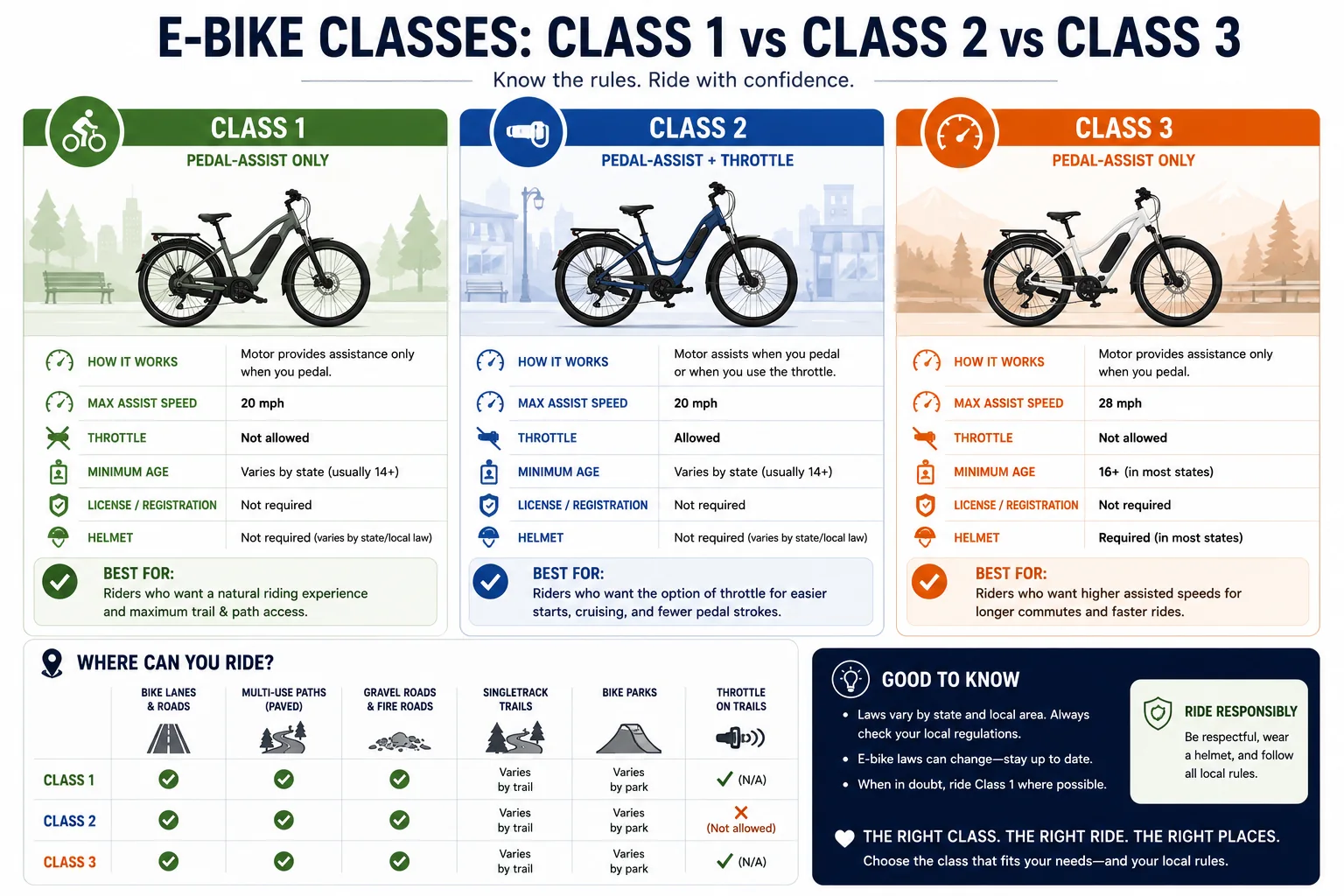
Class 1
- pedal assist only
- assistance up to 20 mph
- usually the easiest class to live with
Class 2
- throttle-capable
- assistance up to 20 mph
- best when easier starts or low-effort riding really matter
Class 3
- pedal assist up to 28 mph
- better for longer or faster commuting
- less universally welcome everywhere bikes go
What the classes actually mean
PeopleForBikes summarizes the widely used three-class system this way: Class 1 is pedal-assist only and stops assisting at 20 mph; Class 2 can propel the bike without pedaling and also tops out at 20 mph; Class 3 is pedal-assist only and stops assisting at 28 mph. In most states the bike also needs operable pedals and a motor under 750 watts.
Why Class 1 is the best default
Class 1 works for more people than any other class because it is simple, accepted in more places, and still solves most real commuting problems. If your route is short to medium, your goal is easier biking rather than scooter-style riding, and you do not want to think too hard about legal edge cases, Class 1 is often the cleanest answer.
When Class 2 makes sense
Class 2 is helpful when a throttle solves a genuine daily problem: starting from lights, getting moving with cargo, recovering from a rough day, or easing home when tired. The trap is buying Class 2 just because throttle sounds better in the showroom. Some riders barely use it. Others rely on it constantly. Be honest about which person you are.
When Class 3 is worth it
Class 3 makes the most sense on longer commutes, faster urban corridors, and routes where holding a higher average speed changes whether the bike can replace a car or transit trip. It is less compelling when your route is short, crowded, or full of path riding where the extra speed advantage mostly disappears.
What buyers often miss
- Access rules vary: local rules still matter, even if the three-class system is common.
- The route decides the value: the right class is about your roads and paths, not abstract performance.
- Class 3 is not automatically better: it can add speed without solving your real problem.
Which class fits which buyer
- Class 1: broadest recommendation for commuters, newer riders, and mixed-use city riding.
- Class 2: better for riders who truly want throttle help, especially with cargo, fatigue, or low-speed starts.
- Class 3: better for experienced commuters on longer or more road-heavy routes.
How to choose by route, not by ego
Class 1 is usually enough when your route includes mixed paths, neighborhood streets, and stop-and-go city riding where higher sustained speed does not change much. Class 2 matters more when repeated starts, hills with cargo, or low-energy days make throttle assistance genuinely useful. Class 3 earns its keep when the route is long enough and open enough that holding more speed actually shortens the trip in a meaningful way.
What most buyers regret
- Class 1 regret: usually comes from underestimating hills, cargo, or fatigue rather than speed itself.
- Class 2 regret: usually comes from paying for throttle and then barely using it.
- Class 3 regret: usually comes from assuming 28 mph support matters everywhere when many daily routes do not let you use that advantage comfortably.
The adult way to decide
Buy the class that best matches your daily route and access rules, not the one that sounds coolest in a product listing. Most people are better served by a bike they can use almost everywhere than by a faster bike that adds legal or route challenges without transforming the trip.
Bottom line
Class 1 is the best default. Class 2 is the practical choice when a throttle genuinely improves daily life. Class 3 is the better tool only when faster commuting is the actual point. Choose around route and access, not around spec-sheet ego.
Need help figuring out which class matches your commute?
How to use this page
This page is reviewed under ElectricBikeCompare editorial standards and published by Nofo Times LLC. The goal is to help you choose around fit, storage, charging, support, safety, and day-to-day ownership, not just the best-looking spec sheet. Where a page leans on manufacturer claims, we cross-check them against the practical tradeoffs buyers usually run into after purchase.
For the full site method, read How We Evaluate E-Bikes or contact info@electricbikecompare.com.